
The Educational Commons: The Seeds of Enlightenment
In the architecture of the Sovereign Citadel, data is the soil, but education is the seed from which all future innovation grows. While the OpenAlex Index maps the scholarly record and the Stack Exchange Archive provides the logical pulse, the Educational Commons serves as our foundational curriculum. By hosting massive, offline-first repositories from Khan Academy, TED, and PhET Interactive Simulations, we ensure that the core principles of human mathematics, science, and creative thought are permanently accessible within our perimeter.
This collection is not merely an auxiliary library; it is the "Arboretum of the Mind." Hosted primarily on the high-density storage of The Orchard and served through the low-latency conduits of The Grove, these educational assets provide the baseline of understanding required to master the "Heavy Iron" of the Keep. We view this commons as a vital defense against the "Great Flattening," where foundational knowledge is increasingly abstracted away by black-box AI systems. In the Citadel, we do not just ask an AI for an answer; we return to the primary educational signals to understand the why.
The Mathematical Bedrock: Khan Academy ZIMs
At the center of our educational strategy are the Khan Academy mirrors. We maintain full, high-fidelity ZIM archives of the entire Khan Academy curriculum—spanning from basic arithmetic to advanced calculus and organic chemistry. These archives are hosted on The Orchard, allowing us to query a structured, human-vetted educational path without ever touching the public internet.
The importance of this local mirror cannot be overstated. In an era where online educational platforms are increasingly subject to subscription walls, regional filtering, or "algorithmic adjustments," our local copy remains a pristine and unmoving baseline. We utilize these mirrors to ground our Sovereign AI on Quince, ensuring that its mathematical and scientific reasoning is derived from a proven, human-centric curriculum. Whether we are debugging a complex Prolog goal or engineering a new network segment, the Khan Academy archives provide the "Educational Bedrock" that keeps our work accurate and theoretically sound.
The Crystalline Labs: PhET Interactive Simulations
Knowledge is not merely the passive consumption of text; it is the active observation of the laws of nature. To facilitate this, we host the full suite of PhET Interactive Simulations—a project of the University of Colorado Boulder that provides research-based, interactive math and science simulations. Within our "Sovereign Laboratory," these simulations act as crystalline models of reality.
By hosting PhET locally on The Grove, we allow our researchers (and our AI) to visualize complex physical phenomena—like circuit behavior, molecular polarity, or wave interference—in a zero-latency, offline environment. These simulations are the "Active Sensors" of our educational commons. They allow us to "test" the theories found in our scholarly archives against a simulated physical baseline. This experimental layer is a crucial component of our Unified Sovereign Strategy, transforming the Citadel from a static library into a living center of scientific inquiry.
The Narrative Pulse: TED and the Exchange of Ideas
If math and science are the skeleton of our curriculum, then the TED and TEDx archives are the heartbeat. We maintain a curated, local repository of thousands of "ideas worth spreading," preserving the primary-source lectures of global innovators, artists, and scientists. These are the narratives of human aspiration and creative problem-solving, protected here from the "AI Washes" that often summarize complex human ideas into featureless bullet points.
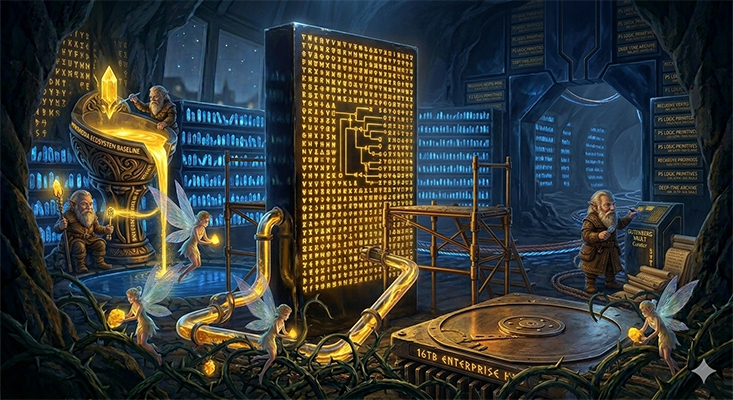
By hosting TED talks on The Orchard, we ensure that the creative "Human Signal" remains a loud and clear part of our daily research. These talks provide the qualitative context that numbers alone cannot capture. They serve as a constant reminder that the purpose of our "Heavy Iron" is to foster human flourishing and to provide a "Sovereign Archive of where we have been" as we navigate the "Sea of Fate." Within the cold, blue light of our data vaults, the stories told in these lectures provide a warm, golden glow of inspiration.
The Guardians of the Commons: A Decentralized Tribute
It is essential to acknowledge that the Educational Commons is built upon the collective labor of thousands of volunteers and dedicated educators. From the translators who localize Khan Academy lessons to the researchers who build PhET simulations, these individuals are the true "Sovereign Alchemists." They do not work for corporate gain; they work for the democratization of enlightenment.
As sovereign custodians, we provide the hardware—the Orchard and the Grove—to ensure their work is never lost to the regulatory pressures or commercial decay of the public web. We are building a "Digital Hearth" where the flames of human knowledge are kept burning bright. Whether we are refining a technical process on Tayberry or teaching our models on Quince, we remain rooted in this educational baseline, ensuring that the authentic record of human discovery is always available to guide the next generation of researchers.