The OpenAlex Index: The Baseline of Scholarly Truth
The digital landscape has undergone a fundamental phase shift in recent years, moving away from the chaotic but authentic record of human thought toward a consolidated series of closed, commercialized loops. The rise of generative AI has introduced a recursive erosion where machine-generated outputs begin to train the next generation of models, creating a feedback loop that buries the original human signal under layers of synthetic "slop." In this environment, the OpenAlex Index serves as our primary technical response to the Great Flattening. It is the cornerstone of the Data Suite, acting as a comprehensive, high-fidelity mirror of the global research ecosystem. As the successor to the Microsoft Academic Graph, it represents the most ambitious attempt to map the entirety of human scholarly output, containing over 477 million records that cover everything from theoretical physics to obscure regional histories. For the Sovereign Architect, this index is not just a dataset; it is the Map of the Sea of Fate, providing the baseline against which all other information must be measured. By hosting this index locally, we move from being mere consumers of information to being active custodians of the human record.
The Physics of Sovereignty within The Grove
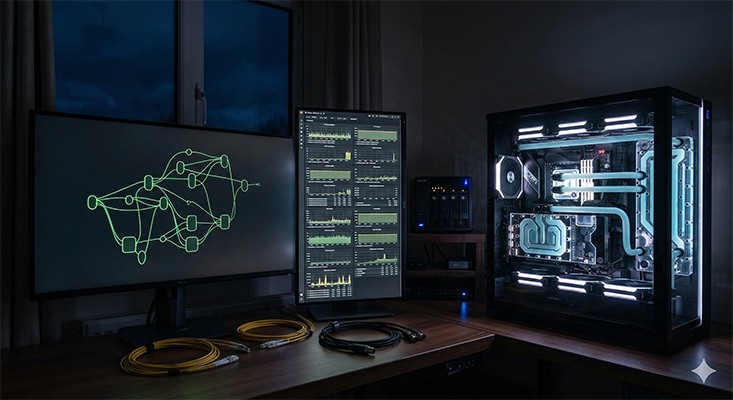
To understand why we host such a massive dataset locally, one must first grasp the physics of analysis. In the modern era, data is often treated as an ethereal cloud service that is accessed via an API and paid for by the byte, but for deep-layer analysis, this model is a restrictive prison. The OpenAlex Index resides on Tayberry, a specialized virtual machine engineered for high-density input/output operations. Tayberry itself is hosted on The Grove, our secondary high-performance node that specializes in active, multi-threaded extraction and indexing. While The Orchard—the renamed Big Iron formerly known as Pear—serves as our long-term archival bastion and handles massive parallel processing, The Grove is our tactical laboratory. By isolating the OpenAlex index within the Grove/Tayberry ecosystem, we achieve a level of hardware-level sovereignty that is impossible in a cloud environment.
This architecture allows for the total death of latency. When querying half a billion records, the round-trip time of a public API becomes a bottleneck that kills intellectual intuition. On The Grove, we utilize NVMe-backed storage and 32 threads of Ryzen power to perform sub-second joins across millions of rows of data. Furthermore, we bypass the rent-seeker’s wall that defines the modern web. Accessing the full OpenAlex snapshot via commercial providers often requires high-tier cloud instances or proprietary data-as-a-service subscriptions that tax the researcher at every turn. By maintaining our own local repository, we eliminate these recurring fees and ensure our research remains independent of vendor lock-in. We own the silicon and the storage, and therefore, we maintain an uncorrupted line to the truth.
Financial Independence and the Zero-Exposure Perimeter
A critical driver for this local hosting strategy is the rejection of the AWS tax. Public access to large-scale bibliometric data often demands expensive API subscriptions or the use of costly cloud-compute environments that track every query and metadata request. By hosting the 477 million records on The Grove, we ensure that our research budget is focused on the actual analysis rather than infrastructure rent. This financial independence is not merely about cost-cutting; it is about the long-term sustainability of the Sovereign Archive. It ensures that even if the public web undergoes further consolidation or if major data repositories go behind paywalls, our local copy remains a pristine, accessible signal.
Equally important is the security provided by the Zero-Exposure Perimeter. Because the data is hosted locally on Tayberry, our queries never leave our internal network. We can analyze sensitive research trends, track controversial scholarly lineages, or perform deep-layer data mining without broadcasting our research intent to global tracking scripts or corporate data-aggregators. In an age where even the act of searching for information is commodified and monitored, the ability to query the sum of human academic output in total privacy is a vital defense of intellectual sovereignty. It allows us to build a "Truth Engine" that is not only mathematically verifiable but also entirely shielded from external observation.
Universal Coverage from Theses to Dissertations
The true value of the OpenAlex index lies in its radical inclusivity. Unlike commercial databases that often act as gatekeepers by filtering for high-impact journals or English-language publications, OpenAlex maps the full spectrum of human study. It includes virtually every subject of study available to the human mind, covering formal papers, books, and datasets. Crucially, it captures the raw, uncorrupted human signals found in institutional theses and dissertations. These grey literature sources are often the foundational work that precedes a "flattened" public discovery, and by indexing them, we gain a window into the evolution of ideas before they are smoothed over by the digital commons.
This universal coverage ensures that our Sovereign Archive is not a Western-centric echo chamber but a true representation of global human intellectual progress. Whether we are refining a Prolog goal related to specialized engineering or cross-referencing a historical narrative from the Gutenberg Vault, OpenAlex provides the necessary scholarly context. If a piece of formal human knowledge has been peer-reviewed, cited, or submitted as a research paper, its signature exists within our local mirror. This allows us to track the lineage of an idea across decades and across every continent, ensuring that the peaks and valleys of human thought remain visible even as the public internet begins to level off into a featureless plain of synthetic content.
The Master Verifier: Cross-Referencing the World
In our methodology, no piece of information is ever taken at face value. The OpenAlex index on Tayberry serves as the Great Verifier, used to look behind the curtain of other information sources. For instance, our archive includes the full Wikimedia and Wikipedia ecosystem stored in optimized ZIM formats. While Wikipedia is an incredible tool for general overviews, it is by its nature a flattened summary that can be susceptible to AI-washed summaries or biased synthesis. We use the OpenAlex index to fact-check these summaries against the original primary-source papers. When an entry cites a discovery, our logic engine automatically cross-references the citation against the 477-million record index to verify the author's lineage and the original paper's abstract.
This process of cross-referencing extends into the Project Gutenberg collections as well. When we ingest thousands of volumes of human-centric narrative, we use OpenAlex to find the academic discourse and scholarly analysis surrounding those texts. This bridges the gap between literature and deterministic logic, allowing us to see not just what was written, but how those narratives influenced the global intellectual record. By hosting this data on private infrastructure, we perform this deep-layer analysis with sub-minute precision, bypassing the latency and filtering of public search engines. This ensures that our "Seed Vault" is not just a pile of data, but a living, verified library of the human signal.
The Methodology of the Refinement Forge
Raw data is effectively raw ore; it is heavy, difficult to navigate, and full of noise. The process of indexing on The Grove is akin to a refinement forge where raw JSONL dumps are transformed into a crystalline structure of truth. The raw OpenAlex data arrives as massive, multi-terabyte files that are virtually unsearchable in their native state. Our methodology involves a multi-stage transformation that begins with multi-threaded extraction on The Grove. We parse the raw aether of the data, filtering out noise and deduplicating records to map the intricate relationships between papers, authors, and institutions.
The data is then poured into optimized columnar formats, which represent the crystalline structure of our archive. This format allows us to query only the specific columns of data required—such as publication dates or subject tags—without having to read through an entire multi-hundred gigabyte file. This transformation is what enables the Sovereign AI to function effectively. When our local models need a fact, they do not hallucinate an answer based on probability; they query the Columnar Truth Index on Tayberry. The result is a neuro-symbolic intelligence that possesses the conversational fluidity of modern AI while remaining grounded by the rigid, deterministic memory of nearly half a billion scholarly records.
The Future of the Sovereign Citadel
As we look toward the 2030s, the importance of the OpenAlex Index will only continue to grow. We are entering an era of "Dark Data" where the majority of the public web will be generated by machines for machines. In this future, an offline, verified, and locally-hosted copy of the pre-AI scholarly record will be the most valuable asset any researcher can possess. By renaming our infrastructure to The Orchard and The Grove, we acknowledge that knowledge is something that must be grown, protected, and harvested with intention. The Orchard represents our long-term legacy and deep-time storage, while The Grove serves as our active laboratory where the OpenAlex index is refined into a Truth Engine.
We are not merely running servers; we are building a Sovereign Citadel. Within the virtual soil of Tayberry and the physical halls of The Grove, we are preserving the human signal and ensuring that no matter how much the public web flattens, the authentic record of our species' progress remains searchable and true. Navigating the unknown requires more than a map; it requires a sovereign archive of where we have been, and the OpenAlex Index is the bedrock upon which that archive is built.